


Growing Sphagnum at Coed Talylan – Try-Out Fund Project Overview
This project at Coed Talylan is supported by the Farming Connect Try-Out Fund and aims to test the feasibility of cultivating Sphagnum moss at small field scale as a potential peat alternative for horticulture. The trial will take place on marginal land characterised by poor drainage, acidic soil, and low fertility — conditions that naturally suit Sphagnum growth.
Why grow sphagnum?
Sphagnum moss is the dominant peat-forming genus in UK bog ecosystems. Its physiological traits — high cation exchange capacity, hyaline water-holding cells, and acidification of its surroundings — slow microbial decomposition and create the anoxic conditions required for long-term carbon accumulation. In intact bogs, this process operates over millennia, producing peat deposits that store large quantities of carbon and regulate catchment hydrology.
Horticultural peat is derived largely from Sphagnum-dominated peatlands, valued for its low bulk density, high water-holding capacity, chemical stability, and predictable performance as a growing medium. However, peat extraction disrupts these ecosystems, oxidises stored carbon, and results in sustained greenhouse gas emissions.
Sphagnum cultivation (paludiculture) offers a potential alternative pathway: producing a renewable, peat-like biomass while maintaining permanently wet conditions that preserve or re-establish peat-forming processes. When grown on rewetted peatlands and harvested rotationally, sphagnum cultivation can align biomass production with wetland restoration objectives.
UK peat use: scale and context
Despite long-standing policy commitments, peat remains a significant input to UK horticulture.
-
Total UK peat use (all sectors): historically ~2.3–2.8 million m³ per year
-
Horticulture share: ~60–70% of total peat use
-
Horticultural peat use: approximately 1.4–1.8 million m³ annually
Of this:
-
The retail amateur sector accounts for roughly 30–35%
-
Professional horticulture (ornamentals, soft fruit, nursery stock, mushrooms, glasshouse crops) accounts for 65–70%
-
Mushroom Cultivation accounts for 30% of professional horticultural peat (~270,000–390,000 m³ of peat per year)
-
While retail peat sales have declined substantially over the past decade, professional use has reduced much more slowly, largely due to performance constraints, crop sensitivity, and lack of fully equivalent alternatives at scale.
Policy and regulatory context (UK)
The UK Government has committed to a progressive transition away from peat use in horticulture during the mid-2020s, supported by a mix of voluntary agreements, regulation, and innovation funding.
Key actors include:
-
DEFRA – policy direction and regulation
-
Royal Horticultural Society – growing media trials and guidance
-
Agriculture & Horticulture Development Board – monitoring impacts on commercial production
Current policy recognises that peat replacement is not a single-material substitution problem, but a systems challenge involving water management, substrate structure, nutrient buffering, and crop-specific performance.
Why sphagnum matters as a peat alternative
Most existing peat-free substrates (wood fibre, bark, green compost, coir) can replicate some peat functions, but not all:
| Function | Peat | Wood fibre | Compost | Coir | Sphagnum |
|---|---|---|---|---|---|
| Water holding | ✔ | △ | △ | ✔ | ✔ |
| Structural stability | ✔ | △ | ✖ | △ | ✔ |
| Low nutrients | ✔ | ✔ | ✖ | ✔ | ✔ |
| Acidic pH | ✔ | ✔ | ✖ | △ | ✔ |
| Biological inertness | ✔ | ✔ | ✖ | ✔ | ✔ |
| UK-sourced | ✔ | ✔ | ✔ | ✖ | ✔ |
Sphagnum is unusual in that it reproduces the functional ecology of peat, rather than approximating it. This makes it particularly relevant for:
-
Propagation substrates
-
Sensitive nursery crops
-
Mushroom casing and specialist horticulture
-
Long-term reduction of imported inputs
Constraints and realism
Sphagnum cultivation is not a short-term replacement for all peat use in the UK.
Key constraints include:
-
Establishment time (2–4 years before harvest)
-
Requirement for permanent rewetting
-
Land availability and water control
-
Current lack of large-scale UK processing infrastructure
However, at landscape scale, sphagnum paludiculture is one of the few peat-replacement pathways that simultaneously addresses climate, biodiversity, and supply-chain resilience.
What BeadaMoss® Trials Have Shown
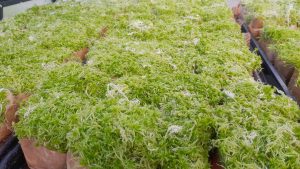 BeadaMoss® (Micropropagation Services EM Ltd) is a UK company leading work on commercial Sphagnum cultivation. Their trials, funded by UK Research and Innovation (UKRI), demonstrated that Sphagnum can be propagated from tissue culture and successfully grown at field scale on re-wetted peatland. Key findings include:
- Micropropagated Sphagnum establishes well on wet, acidic substrates when surface water is maintained.
- Gel-encapsulated “bead” propagules improve survival and ease of handling compared with loose fragments.
- Spring planting and consistent moisture give the best establishment rates.
- Field growth is slow (three to five years to full harvest), but protected or greenhouse conditions can shorten the crop cycle to one to two years.
- Harvested Sphagnum performs well as a structural, moisture-retentive component in peat-free composts.
In the BeadaMoss trials, the best-performing bed variant was:
Shallow, permanently wet beds with controlled water tables and surface microtopography
Key characteristics of the top-performing variant
-
Water table kept at or just below the surface (near-constant saturation)
-
Relatively flat beds with fine-scale microtopography (low hummocks rather than deep ridges) – uneven surface
-
Minimal disturbance after establishment
- Use of fleece is initial establishment of beds
-
Dense initial sphagnum fragments rather than sparse plug planting
Why this variant outperformed others
-
Maximised capillary water supply to growing tips
-
Reduced desiccation stress compared with raised or ridged beds
-
Supported faster lateral spread and vertical growth
-
Lowered weed ingress compared with drier or more aerated variants
Variants that performed worse:
-
Raised or ridged beds that dried at the surface
-
Beds with fluctuating water tables
-
Coarser substrates or excessive organic amendments
Conclusion
The trials reinforced the central paludiculture principle:
Hydrological stability mattered more than substrate complexity.
Stable hydrology and surface capillarity manged through topography dominates outcomes substrate “improvements” do not. Whether sphagnum grows or fails is determined mainly by how water is held and moves at the surface, not by what material the bed is made of.
The question is how to keep the growing tips continuously wet without flooding? Sphagnum has no roots and depends entirely on capillary water movement. If the water table drops even a few centimetres, capillary contact breaks and tips dry out. Whereas flooding submerges the photosynthetic tips, excludes air, and suppresses growth The solution then is to hold the water table at the surface (0 to −2 cm) and maintain a continuous capillary contact between the water and the sphagnum tips, rather than by adding free-standing water, keeping the tips wet by pinning the water in place, not by covering them with water.
European developments in sphagnum farming (paludiculture)
Across northern Europe, Sphagnum farming has moved from experimental research into applied land-use practice, driven by climate mitigation targets, peatland restoration policy, and the need for peat alternatives in horticulture. The unifying principle across these systems is paludiculture: maintaining permanently wet conditions on peat soils while producing usable biomass.
Germany
Germany has led European development, particularly through work coordinated by the Greifswald Mire Centre and regional partners in Lower Saxony and Mecklenburg–Vorpommern.
Key technical characteristics of German systems include:
-
Cultivation on rewetted, formerly drained agricultural peatlands
-
Strict control of the water table at or just below the surface (typically 0 to −5 cm)
-
Large, laser-levelled fields to ensure uniform hydrology
-
Establishment via chopped sphagnum fragments rather than plugs
Reported yields of ~10–15 tonnes dry matter per hectare per year have been achieved once systems are fully established (typically after 2–4 years). Importantly, these yields are obtained without drainage, allowing peat oxidation to be halted and, in some cases, reversed. Life-cycle assessments indicate that such systems can reduce greenhouse gas emissions by several tonnes of CO₂-equivalent per hectare per year compared with drained peatland agriculture.
German projects have also demonstrated:
-
Compatibility with agricultural machinery at field scale
-
Predictable biomass quality suitable for growing media blends
-
Economic viability when integrated with carbon and ecosystem service payments
Netherlands
In the Netherlands, sphagnum cultivation has been developed primarily in the context of peat subsidence control, water management, and circular bioeconomy policy.
Dutch systems tend to be:
-
More engineered, often involving lined beds or sand-capped peat
-
Integrated into complex regional water management infrastructure
-
Focused on high consistency of biomass for horticultural end use
While yields are broadly comparable to German trials, Dutch projects place greater emphasis on:
-
Standardisation of product quality
-
Integration with commercial growing media manufacturers
-
Combining sphagnum production with other wetland crops
These projects demonstrate that sphagnum can be embedded within intensive land-use landscapes, although at higher capital and management cost.
Denmark
In Denmark, sphagnum farming has been explored as part of national peatland restoration and climate mitigation programmes, often on smaller sites and pilot scales.
Danish trials have focused on:
-
Adapting sphagnum cultivation to cooler, wind-exposed conditions
-
Mixed-species sphagnum assemblages to increase resilience
-
Integration with biodiversity and water-quality objectives
Although yields reported to date are generally at the lower end of the German range, Danish work has contributed valuable insight into:
-
Establishment techniques under marginal conditions
-
Long-term system stability
-
Trade-offs between biomass harvest and ecological restoration goals
Key lessons from European experience
Across these countries, several consistent findings emerge:
-
Hydrological control is the primary determinant of success, outweighing substrate amendments or nutrient management
-
Rewetted peat soils can remain economically productive without drainage
-
Sphagnum farming can simultaneously deliver biomass production, emissions reduction, and peatland restoration
-
Time horizons matter: systems require multiple years to stabilise, but then perform reliably
Relevance to the UK
European experience shows that sphagnum paludiculture is technically proven but context-dependent. Germany demonstrates large-scale feasibility, the Netherlands shows integration with commercial supply chains, and Denmark highlights adaptability to northern climates.
For the UK, the main challenges are not biological feasibility but:
-
Site availability and hydrological control
-
Alignment with agri-environment and restoration funding
-
Development of processing and distribution infrastructure
Taken together, European trials provide a robust evidence base that sphagnum farming can form part of a long-term transition away from peat extraction, provided it is approached as a land-use system, not simply a crop.
The Coed Talylan Trial Design
At Coed Talylan, the trial will test Sphagnum cultivation in a series of purpose-built beds on a low-lying, poorly drained field edge. Each bed will measure 3 metres wide by 20 metres long, with edge “bunds” and ditches either side of the length of the bed.
After a sheet mulch to completely suppress existing grasses and rushes, propagules of Sphagnum, “hummocks” purchased from BeadaMoss® — a mix of species propagated for horticultural use — will be planted to establish the beds. Moisture will be monitored using a soil moisture meter provided through the Farming Connect scheme. Irrigation will be managed using sprinklers to maintain the constant moisture levels that Sphagnum requires.
Monitoring will include both moisture-level data and direct measurements of Sphagnum growth depth over time to assess establishment and productivity. The sphagnum will be introduced in early spring 2026, and establishment will be tracked through regular photographic, hydrological, and growth-rate surveys.
The trial will also record data on substrate conditions, hydrology, and seasonal growth rates to assess how Sphagnum performs under semi-cultivated conditions. The intention is to test whether small-scale Sphagnum production could form part of a diversified horticultural system — providing locally produced peat-free material for propagation and nursery use while enhancing soil carbon and water retention.
Here is an overview of the considerations and parameters the trial design:
Bed geometry
-
Bed width: 3m (wider increases hydrological stability)
-
Bed length: 20m
-
Surface relief: ±3–5 cm (low hummocks only; no ridges)
-
Edge bunds: 20cm soil bunds to retain water
- Ditches: -10cm below bed surface level; Parallel to the edge bunds either side of the growing area
Hydrology (critical)
-
Target water table: 0 to −2 cm relative to surface
-
Tolerance: ±1 cm; avoid drawdown events
-
Control: Srinklers, drip tape in ditches
-
Water source: Rain, sprinklers + controlled inflow (ditch)
Substrate
-
Base: Inert mineral subsoil, sheet mulched then rotavated. Topsoil used in edge bunds
-
Surface: No added compost; clean surface reduces competition
-
pH: Acidic (≤5.5); avoid nutrient enrichment (no need for amendment)
Planting
-
Material: Freshly chopped sphagnum fragments (Beada Moss mixed species hummocks)
-
Rate: ~1 kg fresh weight per m² or 12x “hummock” per sqm
-
Method: Even broadcast; lightly pressed into surface water film (or planted hummocks)
Establishment & management
-
Shade: None required as irrigated; site sheltered by woodland edge
-
Disturbance: Zero after establishment
-
Weeds: Manual removal only in year 1
-
Monitoring: Weekly water-table checks in first season
Expected performance
-
Year 1: Lateral closure
-
Year 2–3: Vertical biomass accumulation
-
Harvest: Strip or surface skim at ≥3 years (rotational)
Broader Aims
The project connects practical horticultural innovation with ecosystem restoration. By turning marginal wet ground into productive Sphagnum beds, Coed Talylan’s trial demonstrates a circular model for regenerative horticulture — producing renewable substrate material while supporting biodiversity and climate goals.
Beyond testing Sphagnum growth, the project will also evaluate how dried Sphagnum can be combined with other by-products to create high-quality, peat-free composts. Specifically, it will test mixtures of dried Sphagnum with mushroom compost and pelletised spent coffee grounds — both as a potential propagation medium and as a growing substrate for further mushroom cultivation. This dual-use approach aims to integrate waste recycling and bioresource regeneration within a closed-loop, low-input horticultural system.
The findings will contribute to the wider search for sustainable peat alternatives in Wales and the UK and will be shared through the Farming Connect network once results are available.


