Growing Yacon (Smallanthus sonchifolius) from the Rhizome in the UK Climate
Overview
Yacon is a perennial Andean root crop grown for its crisp, sweet storage tubers, which are rich in fructooligosaccharides. In the UK it behaves as a frost‑tender annual. The top growth dies back with the first frost and the rhizome crown must be lifted and stored overwinter.
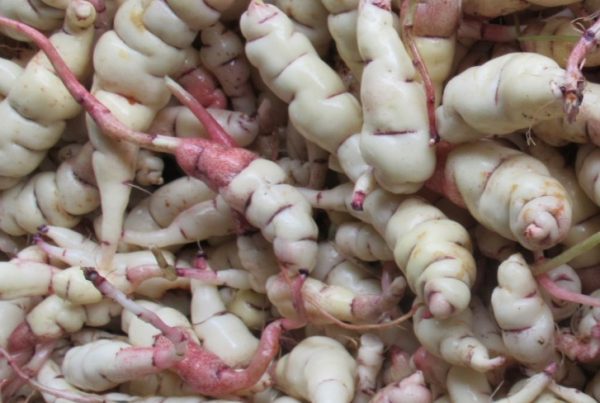
It produces two distinct underground structures. The crown, or rhizome with buds, is used for propagation. The storage tubers are the edible part. These are quite different in appearance and function and should not be confused at harvest time.
Climate Positioning in the UK
Yacon needs a long frost‑free season of roughly five to six months. Planting out is best done in mid to late May, once the risk of frost has passed. Harvest usually falls in October or November, after the foliage has blackened with the first frost. The plant tolerates cool summers but puts on stronger growth during warm spells. It is not hardy in the ground over winter in most parts of the UK.
In maritime climates such as west Wales, growth tends to be steady rather than vigorous. Because most tuber bulking happens late in the season, early establishment in spring is important.
Starting from the Rhizome Crown
Begin in March or April under cover. Choose healthy crowns with visible pink or white buds. Using a clean knife, divide the crown so that each section has at least one viable bud and a small portion of crown tissue attached.
Pot each division into a one to two litre pot filled with a free‑draining compost mix, such as multi‑purpose compost combined with grit or perlite. Set the bud just below the surface. Keep the pots in a frost‑free space between 10 and 18°C and water lightly until new growth appears. Once growth is established, gradually harden plants off before planting out.
Cold, wet compost at this stage is the main cause of failure, so avoid overwatering and ensure good drainage.
Soil Requirements
Yacon prefers deep, fertile soil that retains moisture but drains freely. A pH between 6 and 7.5 is suitable. The crop responds well to generous additions of organic matter.
In April, incorporate one or two buckets of compost per square metre. Avoid heavy nitrogen feeding later in the season, as this encourages lush foliage at the expense of tuber development. In heavier soils, raised beds can improve drainage and early soil warming.
Planting Out
Space plants 60 to 75 centimetres apart, allowing 75 to 90 centimetres between rows. Yacon produces substantial top growth, often reaching 1.5 to 2 metres in good summers, so adequate spacing improves airflow and light penetration.
Plant at the same depth as in the pot and water in thoroughly.
Growing Season Management
Yacon requires consistent moisture for good tuber formation. Extended dry periods reduce both yield and tuber size, so mulching with straw or leaf mould helps stabilise soil conditions.
It is a moderate feeder. A balanced organic fertiliser applied in mid‑June is usually sufficient. Avoid high nitrogen inputs after July.
In exposed sites, staking may be necessary. The hollow stems can snap in strong autumn winds. Pest pressure is generally low, though slugs may damage young shoots and wireworm can be a problem on former pasture.
Tuber Formation
Most tuber bulking takes place from late August through October. Earlier planting in spring significantly increases final yield. In favourable conditions, yields of two to five kilograms per plant are achievable.
In shorter northern seasons, yields may be reduced. A sheltered, south‑facing site can make a noticeable difference.
Harvest
Once the first frost has blackened the foliage, cut the stems down and carefully lift the entire root ball. The tubers are brittle and snap easily, so lift gently.
Separate the smooth, brown or orange storage tubers from the knobbly crown at the top. If you plan to store the crown for replanting, avoid washing it.
Curing and Storage of Tubers
Freshly harvested tubers are less sweet than cured ones. After lifting, leave them in a light, dry place for seven to fourteen days. During this period the skin toughens and sweetness increases.
Store tubers in a dry, frost‑free space at around 4 to 10°C.
Overwintering the Crown
Trim the stems back to two or three centimetres and allow the crown to air dry for a day or two. Store it in barely moist compost, sawdust, or wood shavings in a cool environment between 4 and 8°C. Good ventilation helps prevent rot.
The crown should not dry out completely. An alternative method is to pot the entire crown and keep it frost‑free until spring.
Annual Propagation Cycle
Each year follows a simple pattern: divide the crown, pot the divisions, plant out after frost risk has passed, harvest tubers in autumn, and store the crown again for the following season.
As the crown enlarges, it produces more viable divisions. A single plant can yield approximately three to ten propagules depending on crown size.
Yield Optimisation in UK Conditions
Early indoor starting, soil warming with black mulch, and choosing a warm microclimate all improve results. Protecting plants from early autumn frost with fleece can extend the bulking period and increase yields.
Common Errors
The most frequent mistakes are confusing edible tubers with the propagation crown, planting out too early, overwatering young divisions, applying excessive nitrogen, and harvesting before the main bulking period is complete.
Structural Comparison
In practical terms, yacon behaves more like a dahlia, where the crown must be lifted and stored, than like Jerusalem artichoke, which can remain in the ground over winter.